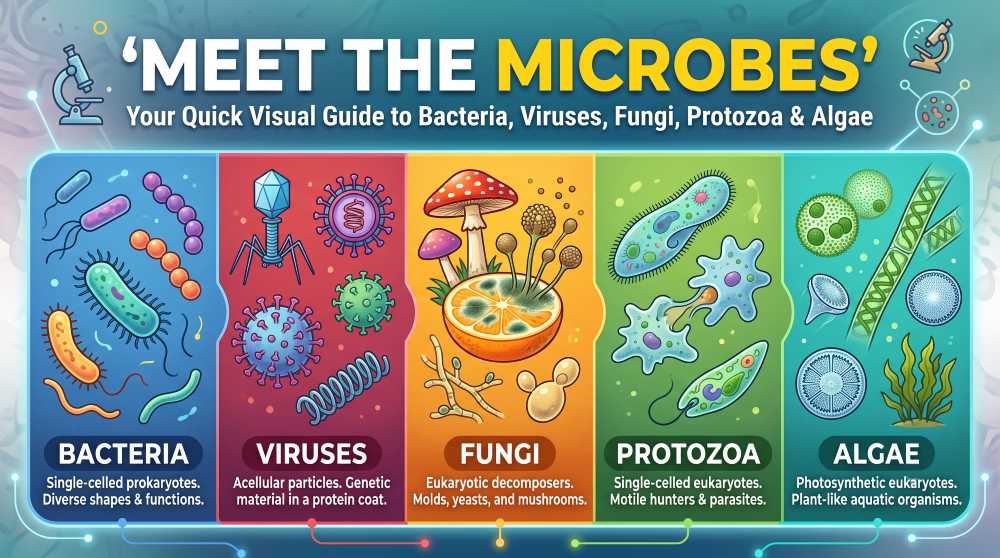
Your Quick Visual Guide to Bacteria, Viruses, Fungi, Protozoa & Algae
Yesterday we stepped into the invisible world. Today, let’s get introduced to the five main types of microbes that share our planet — and our bodies. Think of this as your microbial family portrait.
🦠 1. Bacteria – The Single‑Celled Workhorses
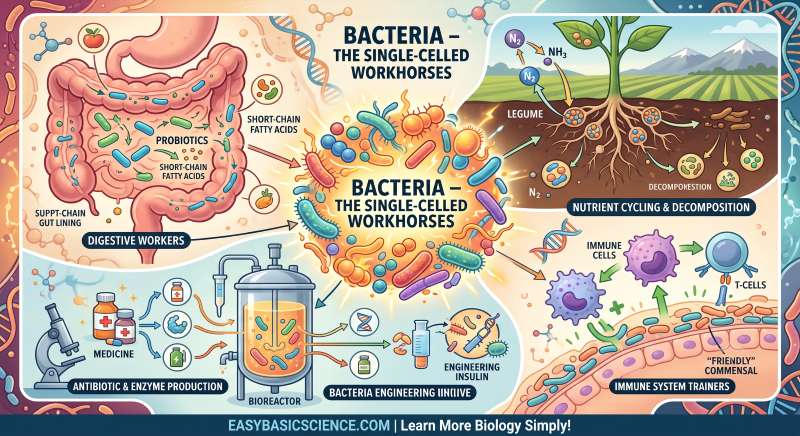
Size: Typically 0.5–5 micrometres. Cell type: Prokaryotic (no nucleus).
Bacteria are the OGs of the microbial world. They come in three classic shapes: rods (bacilli), spheres (cocci), and spirals. Some have a tail (flagellum) to swim, others just float. Most are completely harmless — many are essential. The few that cause disease (like Streptococcus pyogenes, the strep throat culprit) give the whole group a bad name.
- Superpower: Can live almost anywhere — from Antarctic ice to boiling hot springs.
- Fun Fact: The bacteria in your gut outnumber your own human cells by about 1.3 to 1.
🧬 2. Viruses – The Tiny Hijackers
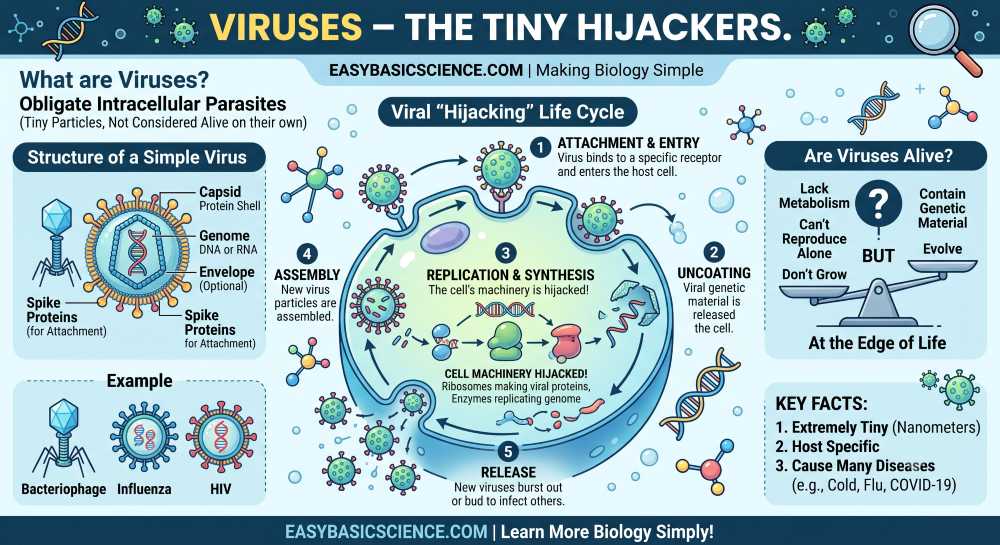
Size: 20–400 nanometres — much smaller than bacteria. Are they alive? Debatable. Viruses can’t reproduce or carry out metabolism on their own.
A virus is basically a bit of genetic material (DNA or RNA) wrapped in a protein coat, sometimes with a greasy envelope. It invades a living cell and turns it into a virus‑copying factory. From the common cold to COVID‑19, viruses are responsible for many familiar illnesses — but bacteriophages (viruses that attack bacteria) may one day save us from superbugs.
- Superpower: Can remain dormant for years inside a host.
- Fun Fact: Bacteriophage T4 looks like a tiny lunar lander, complete with legs and a head full of DNA.
🍄 3. Fungi – Nature’s Recyclers (and Tastemakers)
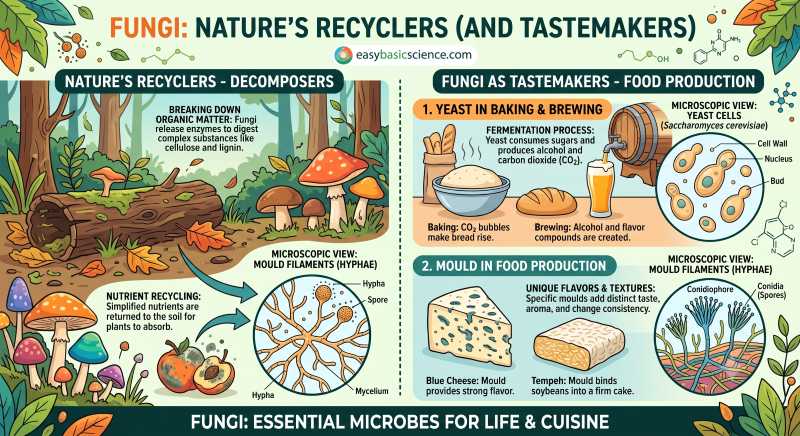
Size: From single‑celled yeasts to sprawling underground networks. Cell type: Eukaryotic (has a nucleus).
Fungi include yeasts (the baking and brewing buddies), moulds (the fuzzy stuff on old bread), and mushrooms. They are nature’s decomposers, breaking down dead wood and leaves. Without them, forests would be buried in debris. Some produce antibiotics (penicillin from Penicillium mould), while a few can cause infections like athlete’s foot.
- Superpower: Can form vast underground networks (mycelia) that can span kilometres.
- Fun Fact: The largest living organism on Earth is a honey fungus in Oregon — its mycelium covers about 9.6 km².
🐾 4. Protozoa – The Single‑Celled Predators
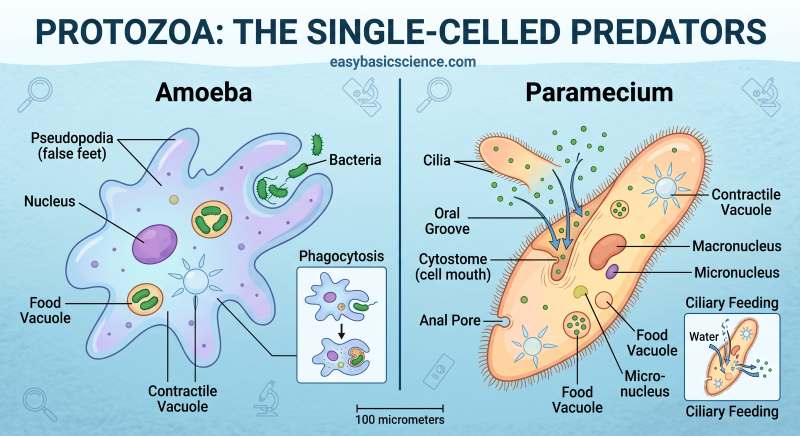
Size: 10–200 micrometres (some are big enough to see without a microscope!). Cell type: Eukaryotic, often with complex structures.
Protozoa are like tiny animals. They move using whip‑like tails (flagella), hair‑like cilia (as in Paramecium), or by oozing along and engulfing their food (like an amoeba). Many live in water and graze on bacteria, while others are parasites — such as the malaria parasite Plasmodium.
- Superpower: Some can form a tough cyst to survive drying out.
- Fun Fact: A single drop of pond water can be a gladiator arena of protozoa hunting bacteria.
🌿 5. Algae – The Tiny Oxygen Factories
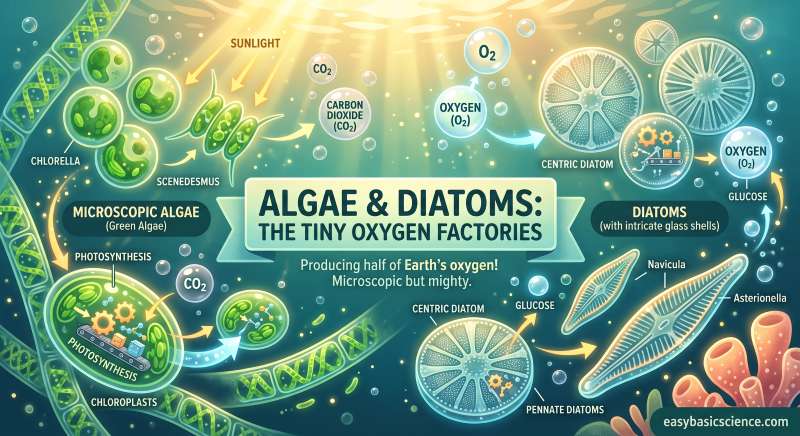
Size: Mostly microscopic, though giant kelp is a visible macroalgae. Cell type: Eukaryotic, containing chloroplasts for photosynthesis.
Algae are plant‑like microbes that live in water. Diatoms have intricate glass‑like shells, dinoflagellates can make the ocean glow, and tiny cyanobacteria (formerly called blue‑green algae) were the first organisms to produce oxygen billions of years ago. Today, marine algae still generate half of Earth’s oxygen.
- Superpower: Produce oxygen and form the base of aquatic food webs.
- Fun Fact: The white cliffs of Dover are made of the microscopic shells of ancient algae called coccolithophores.
🔬 Microbe of the Day: Paramecium
What it is: A slipper‑shaped protozoan covered in tiny hairs (cilia).
Lifestyle: Swims around in freshwater, sweeping bacteria into its “mouth” groove.
Why it’s cool: It can dodge obstacles, mate by exchanging micronuclei, and even discharge harpoon‑like structures to defend itself. A true survivor of the micro‑world.
🎮 Fun Zone: Which Microbe Am I? 🧐🔍
Read each description and pick the correct microbe group!
1. I am a single cell, I have no nucleus, and I come in shapes like rods and spheres. Some of my kind make yoghurt. What am I?
2. I’m not a cell at all – just a strand of genetic material inside a protein shell. I can only reproduce by invading a living cell. What am I?
3. I am a eukaryote, I love breaking down dead wood and old bread, and I gave the world penicillin. What am I?
4. I swim using thousands of tiny hairs, I eat bacteria by sweeping them into a groove, and I’m often the star of pond‑water microscope videos. What am I?
5. I’m green, I make my own food using sunlight, and I’m responsible for about half of the oxygen you breathe. What am I?
🔑 Today’s Takeaway
The microbial world isn’t just “germs.” It’s a diverse cast of characters — from the oxygen‑pumping algae to the pizza‑making fungi and the tiny bacterial factories in your gut. Next time you eat yoghurt, breathe deeply, or see a mushroom, you’ll know exactly who to thank.
👉 Tomorrow we’ll uncover the secret lab techniques microbiologists use to catch and study these invisible creatures — including the famous “Five I’s.” Don’t miss it!
Which microbe group surprised you the most? Share in the comments!