

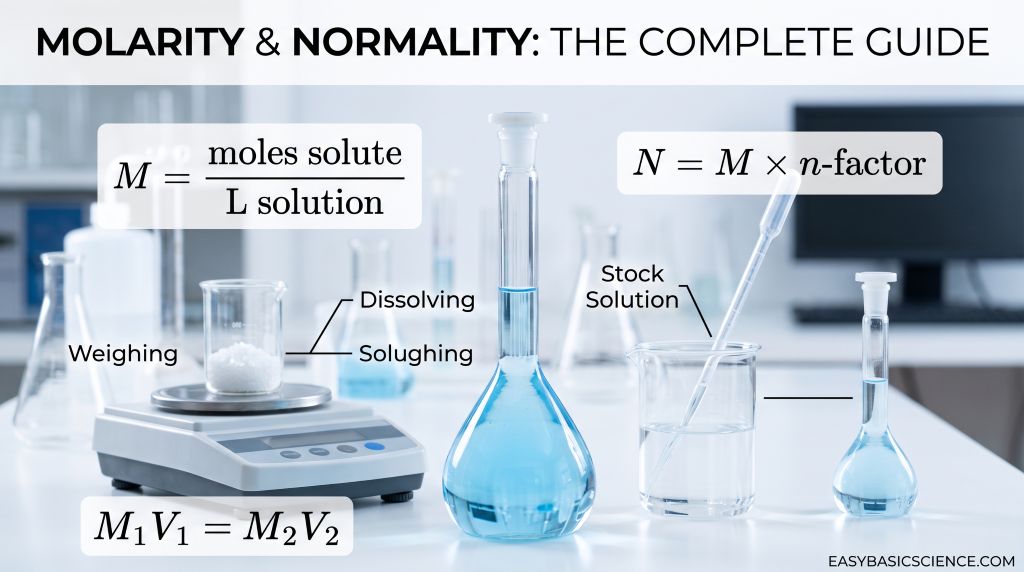
Molarity & Normality
A Practical Guide to Concentration and Solution Preparation for the Laboratory
Whether you are setting up chemistry laboratory reagents or standardizing titration solutions, understanding molarity and normality is essential. While both measure chemical concentration, they serve different operational purposes in chemical analysis. This guide covers definitions, formulas, key differences, and step-by-step solution preparation methods.
Used for preparing standard solutions with high precision
1. What is Molarity (M)?
Molarity (molar concentration) is the number of moles of solute dissolved per liter of total solution. It is the most common concentration unit in analytical chemistry.
Where:
Moles of Solute (n) = Mass of Solute (g) Molar Mass (g/mol)
Units: mol/L or M
NaCl, molar mass = 58.44 g/mol) in enough water
to make 1.0 L of solution yields a
1.0 M NaCl solution.
2. What is Normality (N)?
Normality measures the concentration of reactive species — such as hydrogen ions
(H+), hydroxide ions (OH-), or
electrons transferred in redox reactions — per liter of solution. It is widely used in acid-base titrations
and redox chemistry.
The Molarity–Normality Relationship
The fastest way to calculate normality is by multiplying molarity by the equivalence factor (n), also called the n-factor or valency factor:
-
🔹 For Acids: n = number of acidic protons
(
H+) released per molecule
e.g., n = 1 forHCl, n = 2 forH2SO4 -
🔹 For Bases: n = number of hydroxide ions
(
OH-) released per molecule
e.g., n = 1 forNaOH, n = 2 forCa(OH)2 - 🔹 For Salts / Redox Reagents: n = total positive valency or number of electrons transferred per mole
3. Molarity vs. Normality: Key Differences
| Feature | Molarity (M) | Normality (N) |
|---|---|---|
| Core Definition | Moles of solute per liter of solution | Gram equivalents of solute per liter of solution |
| Formula | M = moles / liters | N = M × n-factor |
| Temperature Dependence | Yes (volume changes with temperature) | Yes (volume changes with temperature) |
| Reaction Dependency | Independent of the reaction | Depends on the specific reaction (n-factor) |
| Common Use Case | General reagent preparation | Titrations and equivalent stoichiometry |
4. How to Prepare a Solution from a Solid Solute
When starting with a dry crystalline powder (like NaOH or
NaCl), you must calculate the required mass and dissolve it to a precise
final volume using a volumetric flask.
Calculation Formula
Calculate and Weigh the Solute
Use an analytical balance. Calculate the exact mass of dry solute needed using the formula above. Weigh the solid on weighing paper or in a clean beaker using a calibrated balance.
Dissolve in a Beaker
Never dissolve solids directly in a volumetric flask. Transfer the weighed solute into a clean beaker. Add approximately 50–70% of the final solvent volume (typically distilled or deionized water) and stir with a glass rod until completely dissolved.
Transfer to a Volumetric Flask
Use a laboratory funnel. Pour the dissolved solution into a clean volumetric flask of the desired total volume. Rinse the beaker and stirring rod 2–3 times with small amounts of solvent and add all rinses to the flask.
Dilute to the Mark (Meniscus Adjustment)
Use a dropper for the final drops. Add solvent until the bottom of the liquid meniscus sits precisely on the calibration line of the volumetric flask at eye level.
Invert and Mix
Ensure homogeneous concentration. Cap the volumetric flask securely and invert it 10–15 times to ensure thorough mixing.
5. How to Prepare a Solution from a Liquid Solute (Dilution)
When working with liquid reagents (such as concentrated acids or stock solutions), you prepare the working solution by diluting a measured volume of the concentrated stock.
The Dilution Equation
Where:
• M1 (or N1) = Initial concentration of stock solution
• V1 = Volume of stock solution required
• M2 (or N2) = Desired final concentration
• V2 = Total final volume of the diluted solution
Example Calculation
To prepare 500 mL (0.500 L) of
1.0 M HCl from a concentrated
12.0 M stock bottle:
HCl while mixing,
and then dilute to the 500 mL mark once cool.
6. How to Calculate the Concentration of Commercial Liquid Acids
Often, liquid acids like Hydrochloric Acid (HCl), Sulfuric Acid
(H2SO4), or Nitric Acid
(HNO3) are supplied as commercial concentrated solutions.
The bottles typically do not state the Molarity or Normality directly. Instead,
they provide the Percentage Purity (w/w%) and the
Specific Gravity (Density).
Essential Formula for Concentrated Acid Normality
HCl, the n-factor is 1, so the Equivalent Weight equals
the Molar Mass (36.46 g/mol).
Example: Making a 1 N HCl Solution from 35% HCl
Suppose you need to prepare 1 L (1000
mL) of a 1 N HCl solution, and you
have a commercial bottle of concentrated HCl with the following specifications:
- Purity: 35%
- Specific Gravity: 1.18 g/mL
- Equivalent Weight of
HCl: 36.46
Step 1: Calculate the Normality (N1) of the Concentrated 35% HCl
N1 = 413 / 36.46 ≈ 11.33 N
(Since HCl is a strong monoprotic acid with an n-factor of 1, its Molarity
(M1) is also 11.33 M.)
Step 2: Use the Dilution Equation to Find the Volume to Extract (V1)
Now, apply the standard dilution formula N1V1 = N2V2:
- N1 (Conc. Acid) = 11.33 N
- V1 (Volume to extract) = ?
- N2 (Desired Normality) = 1.0 N
- V2 (Desired Volume) = 1000 mL
V1 = 1000 / 11.33 ≈ 88.26 mL
🧪 Procedure
HCl: Measure
88.26 mL of the 35% concentrated HCl.
Add this slowly to about 700 mL of distilled water
in a 1 L volumetric flask, mix gently, and then add more distilled
water until the meniscus reaches the 1000 mL mark.
📐 Pro Tip: Always label your prepared solutions with the concentration, date, and your initials for proper lab documentation.
Happy experimenting! 🧑🔬
🧮 Molarity & Normality Solution Calculator
Prepare chemical solutions from solids or concentrated liquid stocks